
Reviewed · BOLOGNA WALKING TOURS & CITY HIGHLIGHTS
Bologna Murder Mystery: Self-Guided City Quest
Bologna turns you into a detective. This offline app quest lets you pick your own start and stop times, while 11 puzzle challenges nudge you through real Bologna landmarks. It’s a simple way to mix first-time sights with side streets, without needing a guide to keep the pace moving.
The trade-off with any self-guided story is that the mystery thread can feel less tight than the landmark facts. You’ll also want to pay attention to the on-screen prompts so you don’t wander too far off-route.
In This Review
- Bologna Murder Mystery: City Quest Basics (and Why It Works)
- What You’ll Like Most: App Controls, Offline Clues, Real Streets
- Walking Bologna With the App: How the Quest Plays
- The Case File Stops: What You’ll See and What to Look For
- Porta Galliera: A Baroque Gate With a Built Date
- Piazza VIII Agosto: The Big Market Energy
- Arena del Sole: A Theatre With a Comeback Story
- Fountain of Neptune: Bronze Details and a Lost Commission
- The Oratory: A Small Church With a Door Beneath It
- Basilica di San Petronio: The Cathedral With an Unfinished Facade
- The Baroque Church Interior: Sorrow Over Dead Christ by Niccolò dell’Arca
- The Two Leaning Towers: Asinelli and Garisenda
- The Old University Area: Classes Before a University Building
- Park of Montagnola: Napoleonic-Era Green Space
- Bologna Cathedral (Saint Peter): Mostly 17th-Century, Still a Key Seat
- Archiginnasio: A Fast Build for the Studium
- Palazzo dei Banchi: A Facade Designed to Hide the Market
- Price and Value: Why $6 Makes Sense for the Right Traveler
- Getting Around Bologna’s Streets Without Losing the Plot
- Who Should Book This Murder Mystery Quest?
- Should You Book It? My Take
- FAQ
- How long is the Bologna Murder Mystery: Self-Guided City Quest?
- Do I need an internet connection to play?
- What language is the experience offered in?
- How many puzzle challenges are included?
- Can I start and stop whenever I want?
- Where does the quest start and end?
- Is there a physical guide with the tour?
- Is this a private experience?
- Are service animals allowed?
- What’s the cancellation policy?
Bologna Murder Mystery: City Quest Basics (and Why It Works)
This Bologna “murder mystery” is really a city-walking game wrapped in a storyline. You use a mobile access code and follow the Questo app, which gives you challenges tied to specific places. The format is built for flexibility: you can choose when you begin, and you can pause and resume anytime.
One big practical plus is that you don’t need an internet connection to play. That means less battery panic, and fewer data worries on mobile plans. You’ll still get a full hour or so of activity, built around walking and looking closely.
At $6.00 per person, the value is in what you’re paying for: a guided-style route and prompts without paying for a live guide. Since the tour is private for your group, it also avoids the “waiting for the slowest person” problem that can slow group tours down.
What You’ll Like Most: App Controls, Offline Clues, Real Streets
Flexible timing means you’re not stuck to a rigid departure time.
Offline play keeps your data use at zero while you work the clues.
Puzzles tied to landmarks help you notice details you’d normally walk past.
Private group format keeps the experience calmer for families or friends.
English language support makes it a good pick if you want the story and prompts in plain language.
More of the old town on foot, towers and squares and back streets.


Walking Bologna With the App: How the Quest Plays
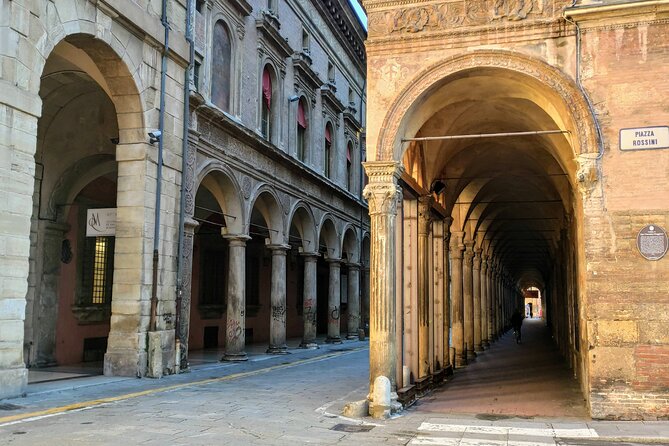
You meet at P.za XX Settembre, 15 and the experience guides you step by step to Piazza Rossini via the Questo app. From there, you work your way through a set of major stops around central Bologna.
The whole quest runs about 1 hour on average. That timing matters, because Bologna is a city where you can easily “accidentally” stay out for two hours. This game gently channels your time into a tight loop: look here, solve this, move on.
The app experience is also designed to let you go at your speed. If you want a few extra minutes at a viewpoint, you can. If you need to stop for gelato or a quick bathroom break, you can pause and come back to the story when you’re ready.
And because you’re following instructions, not a tour guide who talks continuously, you’re free to do the best kind of sight-seeing: short bursts of attention, then real wandering.
The Case File Stops: What You’ll See and What to Look For
The quest ties answers to what’s in front of you. That’s the secret sauce: the puzzles aren’t trivia for trivia’s sake. They’re meant to push you toward details you can spot on foot.
Here’s what you’ll encounter as you make your way through the route.
Porta Galliera: A Baroque Gate With a Built Date
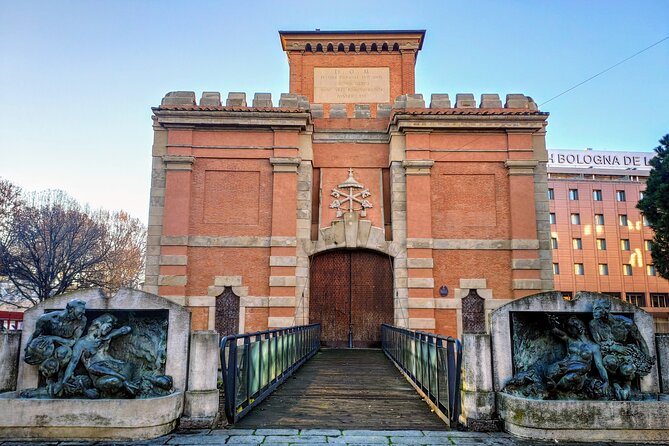
You start by checking out Porta Galliera, one of the most ornamented remaining city gates from Bologna’s older medieval walls. It was built between 1659 and 1661, designed by architect Bartolomeo Provaglia.
If you like architecture, spend an extra minute here even if you’re tempted to race ahead. Gates are easy to ignore when you’re moving fast through a city, but Porta Galliera is the kind of structure that rewards close looking.
The puzzle approach at this stop is straightforward: you’ll be asked to search around to find the clue that advances you to the next location.
Piazza VIII Agosto: The Big Market Energy
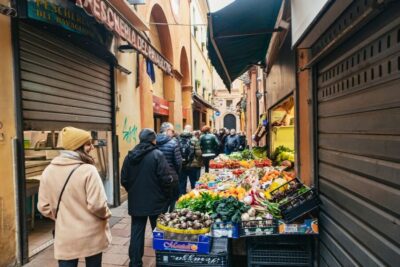
Next up is Piazza VIII Agosto, known for the large market that runs traditionally on Friday and Saturday. On those days, you’re looking at over 400 street stalls.
This is one of those spots where the game meets real daily life. Even if you’re not shopping, the market atmosphere gives you something to watch while you solve. It also helps explain why the quest is such a good fit for groups—people can browse for a minute, then regroup for the next clue.
Set your own pace with an audio guide or a city quest.



Arena del Sole: A Theatre With a Comeback Story
You’ll pass by the Arena del Sole, a historic theatre in Bologna. Its origins date to 1810, and it reopened in 1995 after eight years of reconstruction.
This stop works well if you like places with pasts that didn’t go perfectly smoothly. The game nudges you to look around here too, turning what could be a quick photo stop into a quick “spot the clue” moment.
Fountain of Neptune: Bronze Details and a Lost Commission
Then comes one of Bologna’s most recognizable visual treats: the Fountain of Neptune. The fountain was completed in 1565, and the large bronze Neptune figure was fixed in place around 1567.
The clue-building detail I like most here is the story of its designer. The figure was connected to an early design by Giambologna, who had submitted a model for the Fountain of Neptune in Florence but lost that commission to Baccio Bandinelli.
Even if your brain is in puzzle-mode, this is a stop where the craft shows. Look for the figure and surrounding elements, because the game expects you to notice something specific.
The Oratory: A Small Church With a Door Beneath It
You’ll also see an oratory built between 1481 and 1497. It was built by the celestine fathers from the nearby church of San Giovanni Battista. The site sits below an area that includes a structure of an ancient door from early medieval walls, and an old image of the Madonna protected by a tabernacle.
This is a good example of what makes Bologna feel different from “just museums and monuments.” It’s layered. The quest turns that layering into a scavenger hunt, so you’re not just reading plaques—you’re actively checking details.
Basilica di San Petronio: The Cathedral With an Unfinished Facade
Dominating the scene is Piazza Maggiore and the Basilica di San Petronius. Construction began in 1390, and the main facade has remained unfinished.
The basilica is dedicated to Saint Petronius, who was bishop of Bologna in the fifth century. This matters for the experience because it changes how you interpret the building: it’s not just a big Gothic-looking church. It’s tied to Bologna’s identity.
The quest prompts you to look around and find the answer on-site, which is a better approach than trying to memorize dates and names before you get there.
The Baroque Church Interior: Sorrow Over Dead Christ by Niccolò dell’Arca
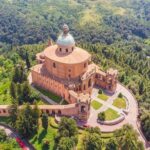
You’ll reach a baroque church whose story is heavily tied to its sculptural centerpiece. Construction began 1687–1690, with designs by Giovanni Battista Bergonzoni. The plan is elliptical, and the dome was designed by Giuseppe Tubertini, completed in 1787. The facade was added later, in 1905.
Inside the sanctuary is the sculptural group Sorrow over Dead Christ (1463) by Niccolò dell’Arca.
This is the kind of stop that can quietly become a highlight, even in a game format. If you’re the type who likes art but doesn’t want a lecture, this works because your attention gets guided by the puzzle, and your eyes land on the sculpture.
The Two Leaning Towers: Asinelli and Garisenda
Bologna gives you its signature skyline moment with the Asinelli and Garisenda towers. The taller one is Asinelli. The smaller one, which leans, is Garisenda.
Their names come from the families traditionally credited with constructing them between 1109 and 1119. Even if the clue doesn’t require math or Latin, the dates are useful context. You’re looking at something that’s been shaping the city’s visual identity for centuries.
The Old University Area: Classes Before a University Building
Next, the quest points you to the story of learning in Bologna. The oldest university in Europe didn’t have a permanent base until later in the Renaissance. Before that, classes were held in professors’ homes (many lived around here) or in public spaces like this one.
This is a great stop for anyone who wants their walking tour to include ideas, not just buildings. The puzzle makes you slow down, then notice how public space served real education.
Park of Montagnola: Napoleonic-Era Green Space
You’ll also visit the Park of Montagnola, a public park in Bologna. Its original construction dates to 1805, during Napoleonic rule, when the park design was commissioned from Giovanni Battista Martinetti.
This stop gives your legs a breather. It’s also a reminder that Bologna’s history isn’t only in churches and towers. It’s in how cities planned space for people to gather.
Bologna Cathedral (Saint Peter): Mostly 17th-Century, Still a Key Seat
Then it’s Bologna Cathedral dedicated to Saint Peter. Most of the current building dates from the 17th century, with a few parts from the late 16th century. It’s also the seat of the Archbishop of Bologna.
For the quest, this helps keep things grounded. You’re not chasing fantasy sightseeing. You’re moving through places that still function as important civic and religious spaces.
Archiginnasio: A Fast Build for the Studium
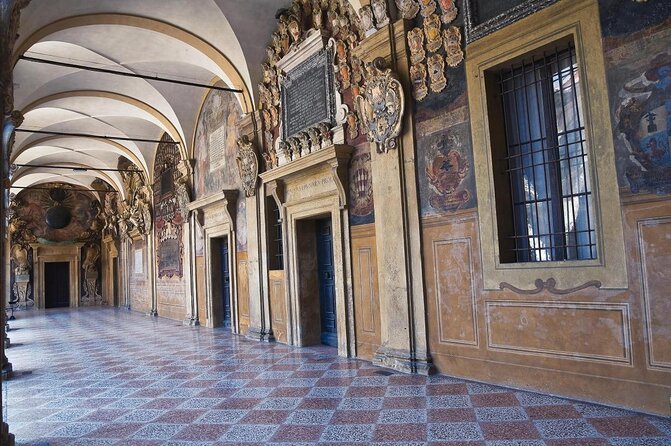
One of the most interesting time-jump moments comes with the Archiginnasio. Work began at the end of February 1562, and the building was inaugurated on October 21, 1563. It was named Archiginnasio after a classical term used to describe the Studium, the university’s earlier name.
That quick build timeline makes it a fun “wait, how fast?” stop. The game pushes you to look for answers here too, so you’ll likely read more than you would if you were just snapping photos.
Palazzo dei Banchi: A Facade Designed to Hide the Market
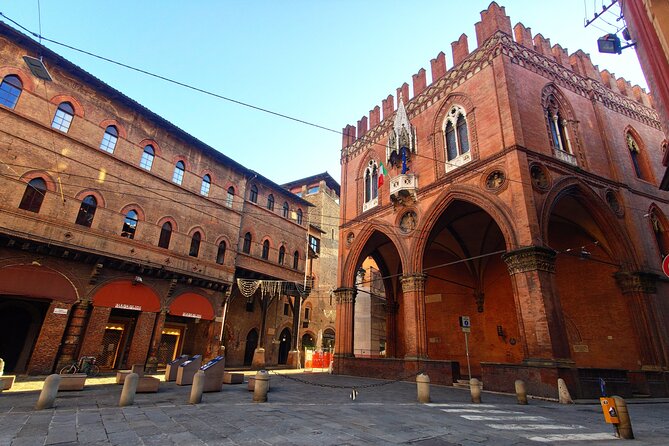
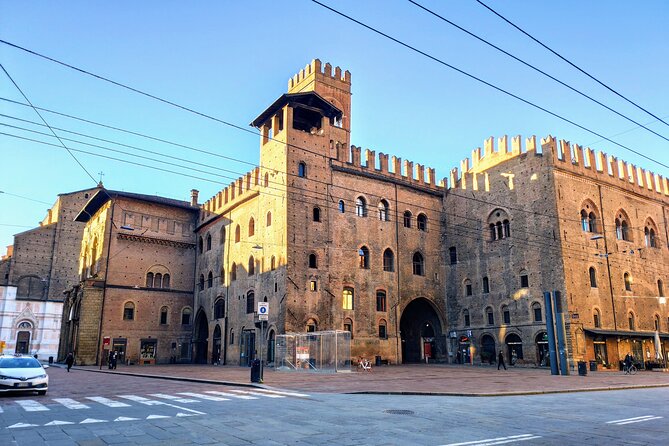
Finally, you’ll reach Palazzo dei Banchi in Piazza Maggiore. It was the last building erected there, designed by Vignola in the 16th century. Its spectacular facade was intended to hide the alleys of the rear market.
The name connects to the ancient presence of currency exchange “banks.” It’s a clever reminder that markets weren’t separate from grand architecture. They were in the same web of city life.
Price and Value: Why $6 Makes Sense for the Right Traveler
At $6.00 per person, you’re paying for a self-guided structure plus a story wrapper. For a one-hour activity, it’s hard to beat this kind of “pay once, explore at your pace” format.
This is especially good value if you’re traveling in a group that doesn’t want to wait for a guide, or if you’re bringing kids who do better with short tasks than long speeches. The quest uses 11 puzzle challenges and real-world clues. That’s what keeps the experience from turning into a casual walk with no payoff.
You should know one key limitation: because there’s no physical guide included, you won’t get added context on demand. The app helps you find answers, but if you want deep explanation of sculpture or theology, you may still want to do a little extra reading later.
Getting Around Bologna’s Streets Without Losing the Plot
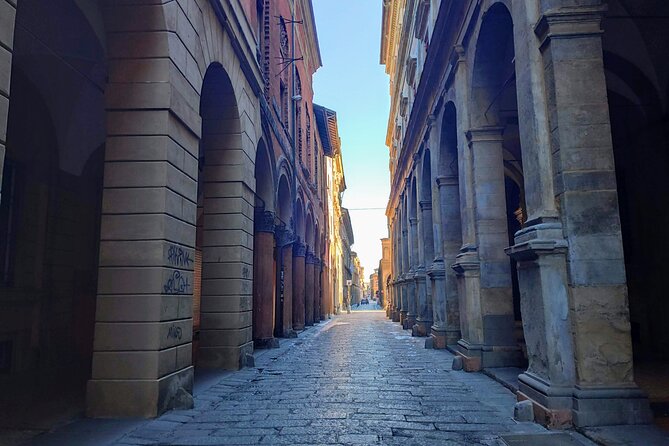
Bologna is compact, but the center has enough lanes and small turns to make you feel like you’re in a maze at least once. That’s where the app helps, because it’s step-by-step and prompts you to look around where you are.
Still, plan your mindset. If you’re the type who hates feeling slightly uncertain, you might find yourself moving slower while you check the screen and keep orienting yourself. If you’re fine with a little exploration, this format becomes fun.
A practical tip: give yourself a buffer. Since the experience runs about an hour on average, you’re not trying to squeeze it between two trains. Let it be its own mini-adventure, then continue your day afterward.
Who Should Book This Murder Mystery Quest?
I think this is a strong fit if you:
- Like walking and don’t mind solving small challenges as you go
- Want a guided-feeling route without paying for a live guide
- Travel with families or friends who prefer independence
- Are comfortable reading prompts in English
It’s also a good option if you’re tired of the same “top sights only” routine. The game’s strongest move is that it pushes you to pay attention to details at major landmarks—gates, piazzas, towers, theatres, fountains—not just take in the broad shapes.
Should You Book It? My Take
I’d book this when I want Bologna to feel playful and active, not lecture-heavy. The offline app plus 11 puzzle challenges makes it feel like more than a basic walk, and the price is friendly enough that you won’t feel like you must rush.
Skip it if you want a tight, fully logical mystery that explains everything cleanly, because the story thread can feel a little loose. Also skip it if you don’t enjoy navigating by prompts or if you’d rather have a person answer your questions in real time.
FAQ
How long is the Bologna Murder Mystery: Self-Guided City Quest?
It takes about 1 hour on average.
Do I need an internet connection to play?
No. The quest does not require an internet connection to play.
What language is the experience offered in?
It’s offered in English.
How many puzzle challenges are included?
There are 11 puzzle challenges.
Can I start and stop whenever I want?
Yes. You can choose your own beginning and end time, and you can pause or resume anytime.
Where does the quest start and end?
It starts at P.za XX Settembre, 15, 40121 Bologna (BO), Italy and ends at P.za Rossini, 1, 40126 Bologna (BO), Italy.
Is there a physical guide with the tour?
No. It’s self-guided and app-based, with step-by-step guidance through the Questo app.
Is this a private experience?
Yes. Only your group participates.
Are service animals allowed?
Yes, service animals are allowed.
What’s the cancellation policy?
Free cancellation is available up to 24 hours in advance for a full refund.
More Self-Guided Tours and City Quests
More Bologna Walking Tours

More Tour Reviews in Bologna



After something different? More ways to fill a day in Bologna and across Emilia-Romagna








Bologna Walking Tours & City Highlights, compared.
 ★ 4.5City Center Walking TourFrom $263,478 reviews
 ★ 4.8Walking Food Tour with a Local GuideFrom $90882 reviews
 ★ 5.0Private Half Day Parma Food Walking TourFrom $134561 reviews
 ★ 3.7Open Bus City Tour and Local Food TastingFrom $46550 reviews
 ★ 5.0Bologna Private Highlights & Hidden Gems Tour with a LocalFrom $77359 reviews
 ★ 4.6City Highlights Walking Tour with Local GuideFrom $17219 reviews
 ★ 4.9City Center Guided Wine Walking TourFrom $70210 reviews
 ★ 4.2City Walking TourFrom $27203 reviews
Browse the lists this tour appears in