
Reviewed · CITY TOURS
Discover Bologna an amazing city
Bologna rewards slow curiosity on a smart private loop. This private tour with longtime Bologna resident Manuela Roversi is a fast, friendly way to get oriented, with history that actually sounds human instead of textbook. I love how the route hits the big monuments without feeling rushed, and I also like that many stops are free to enter, so your money goes mostly to the guide and your group’s time.
One thing to plan for: a dress code is required for places of worship, and the Seven Churches complex is closed on Mondays, so your day matters.
In This Review
- Key highlights worth knowing
- A 3-hour Bologna opener that helps you walk like a local
- Where you meet: Piazza Maggiore is the perfect launchpad
- Practical note
- Piazza del Nettuno and the trident that shows up in car logos
- Via Rizzoli: the Roman spine and the medieval skyline
- Why this stop is useful
- Basilica di San Petronio: a church where astronomy and power meet
- Quadrilatero: eat your way through medieval narrow streets
- What I’d do at Quadrilatero with the tour fresh in your head
- Archiginnasio di Bologna: the university story on decorated walls
- Optional add-on: the old anatomy theatre
- Piazza Santo Stefano and the Seven Churches area
- Basilica-Santuario di Santo Stefano: a complex with layers of time
- Strada Maggiore and Casa Isolani: Bologna’s portico height story
- Why I think this stop works
- Le Due Torri: Asinelli and Garisenda, built by families
- Price and value: $125.10 per group, and why that can be a good deal
- Tips to make your 3 hours feel like more than 3 hours
- Should you book this Bologna private tour?
- FAQ
- How long is the Bologna tour?
- Is the tour private and how large is the group?
- What language is the tour offered in?
- Where does the tour start and end?
- Are entrance tickets included?
- Is there a dress code?
- Is the Santo Stefano complex open every day?
Key highlights worth knowing
- Private, small-group pacing so you can ask questions and keep moving when you want
- Manuela Roversi’s local perspective tied to real neighborhoods, not just famous spots
- Two Towers + Roman axis in one half-day route, including Via Rizzoli and the leaning legends
- San Petronio’s longest covered sundial and the big historic moments tied to the church
- Quadrilatero food market in medieval-style narrow streets (food/drinks not included)
- Archiginnasio with an optional anatomy theatre you can add on for a small fee
A 3-hour Bologna opener that helps you walk like a local
If Bologna is new to you, this tour is designed to fix the biggest problem: you arrive with a map and still feel unsure where to start. In about 3 hours, you’ll trace a sensible path through the historic core, from Piazza Maggiore toward the Two Towers and the Santo Stefano area. You’ll get enough context to understand what you’re looking at, and enough landmarks to make the rest of your trip feel easier.
The tour is private, offered in English, and priced at $125.10 per group (up to 10). That matters. When you travel in a group size like this, you’re often paying for a guide’s time, not for entry tickets. Many of the stops here are free, which makes the pricing feel more fair.
More ways to get the measure of Bologna.


Where you meet: Piazza Maggiore is the perfect launchpad
Your tour begins at Piazza Maggiore, 1/e, 40124 Bologna. Starting here is smart because you’re instantly in the city’s central stage: the square is tied to Bologna’s old roots and is ringed by major buildings you’ll hear about again later in the day.
You’ll spend about 30 minutes at Piazza Maggiore, with your guide pointing out the main players:
- the Neptune fountain
- Basilica of San Petronio
- older town halls and public buildings around the square
- Palazzo dei Banchi and Sala Borsa
This is the moment where you should slow down and look up. Bologna’s power is in its civic buildings and the way streets funnel people through narrow corridors and arcades. If you get the geometry right early, you’ll understand the city far better later—especially when you start seeing the towers.
Practical note
Even though this is a short tour, you’ll still do real walking in the historic center. Wear footwear you trust, because the streets you’ll cover are the classic Bologna ones: made for strolling, not racing.
Piazza del Nettuno and the trident that shows up in car logos
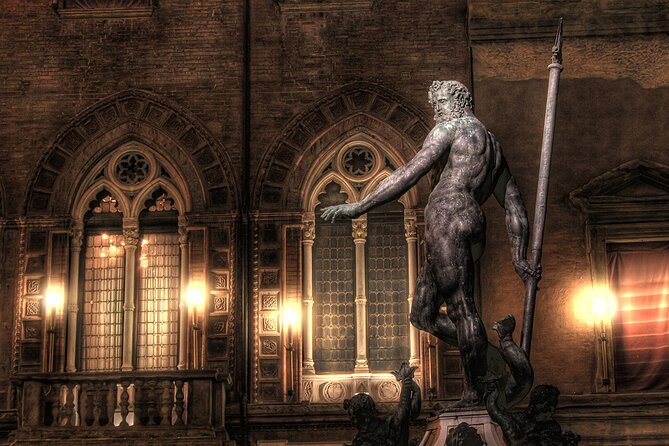
From Piazza Maggiore, the route moves you to the Fontana del Nettuno in the eponymous square. Your stop is about 10 minutes, and that’s just enough time to appreciate what makes this fountain more than a pretty photo spot.
This fountain is known as a monumental civic work, tied to Mannerist taste from the mid-sixteenth century. The fun detail your guide will likely connect is the trident. The Neptune trident was used by the Maserati brothers as an emblem for their first car, and it still shows up as the Maserati logo.
That’s the kind of connection I like on a first tour. You’re not just learning art history. You’re learning how Bologna leaves fingerprints in modern life.
Via Rizzoli: the Roman spine and the medieval skyline
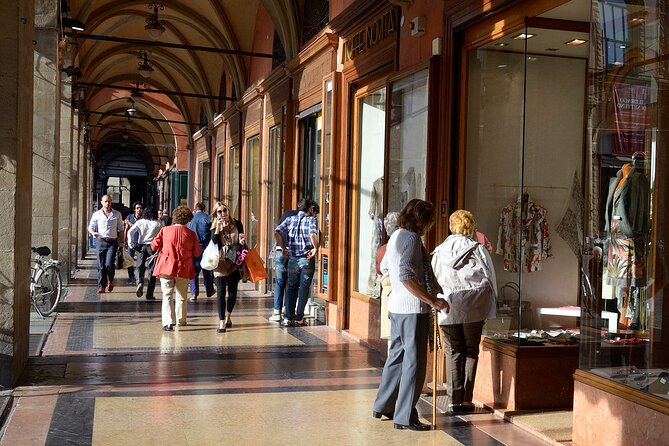
Next comes Via Rizzoli, about 10 minutes on your timeline. This street matters because it follows the city’s old Roman axis, tracing the path linked to the Via Emilia built in the 2nd century B.C. If you like “how a city got built,” this stop gives you the origin story without a lecture.
On Via Rizzoli, your guide will help you connect street lines to what’s visible around you. This is one of the best stretches for spotting the two leaning medieval towers—Bologna’s signature forms—and understanding why this area feels like a crossroads between eras. You’ll also hear about Via Indipendenza, a shopping area you’ll probably pass later on your own.




Why this stop is useful
If you ever feel lost in Bologna, it’s usually because the city can look like layers stacked on top of each other. Via Rizzoli gives you a line to follow: Roman infrastructure that shaped what came after.
Basilica di San Petronio: a church where astronomy and power meet
Plan on about 20 minutes here at Basilica di San Petronio. This is one of the day’s big “slow down and look up” moments.
San Petronio is famous for major historic events. It’s tied to the moment when Charles V became the last Holy Roman Emperor crowned by a pope in 1530. The church also hosted a section of the Council of Trent, connected with the Counter-Reformation.
Then comes the science detail that makes this place memorable: a meridian line inlaid in the paving of the left aisle from 1655. It’s described as the longest covered sundial in the world. That detail alone is worth the stop, even if you’re not usually into instrumentation.
The drawback you should respect: dress code
A dress code is required to enter places of worship. If you show up in clothing that doesn’t meet the standard, you might be refused entry. If you’re traveling in warmer months, bring a light layer that covers shoulders/legs enough to be safe.
Quadrilatero: eat your way through medieval narrow streets
The stop at Quadrilatero is about 20 minutes, and it’s where Bologna’s food identity comes to life. Bologna has a local nickname, La Grassa, and your guide ties that reputation directly to this area.
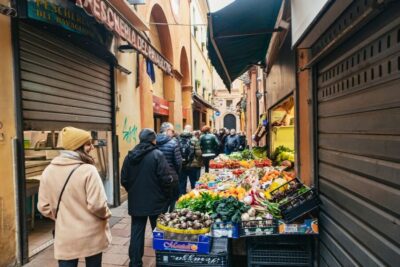
The Quadrilatero is an ancient food market zone with narrow streets and old-style food stalls. The streets can feel packed because the area is built for close contact—vendors selling right into tight passageways, the kind of scene that looks like it has barely changed.
Important reality check: food and drinks are not included in the tour price. That doesn’t mean you shouldn’t snack. It just means you should treat this stop like a map for your own eating later: you’ll see where the action is, so you can decide how adventurous you want to be with your own budget.
What I’d do at Quadrilatero with the tour fresh in your head
Walk the lanes at a relaxed pace and remember what your guide points out: not just the stalls, but the street rhythm. Then later, if you want the same flavors, you’ll know exactly where to go without re-planning from scratch.
Archiginnasio di Bologna: the university story on decorated walls
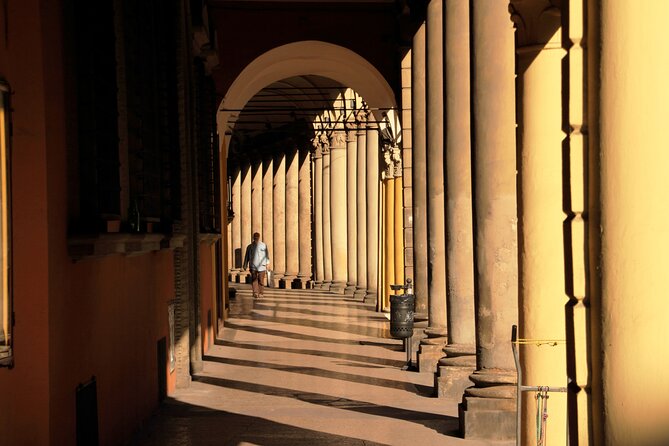
Your next stop is Archiginnasio di Bologna, about 30 minutes. The building’s purpose was practical: it was meant to give unit seating for university teaching that had been spread across various locations. In other words, Bologna built a home for learning.
What catches attention quickly is the decoration. The rich decorations are described as the biggest existing heraldic wall complex. Your guide can help you read this as more than ornament—an image system for status, identity, and the university’s place in civic life.
Optional add-on: the old anatomy theatre
There’s also a possible detour on request: the old anatomy theatre. Entrance is €3.00 per person, paid directly by you on the tour date. If you have any curiosity about how education worked in earlier centuries, this can add extra wow value for a small cost.
Piazza Santo Stefano and the Seven Churches area
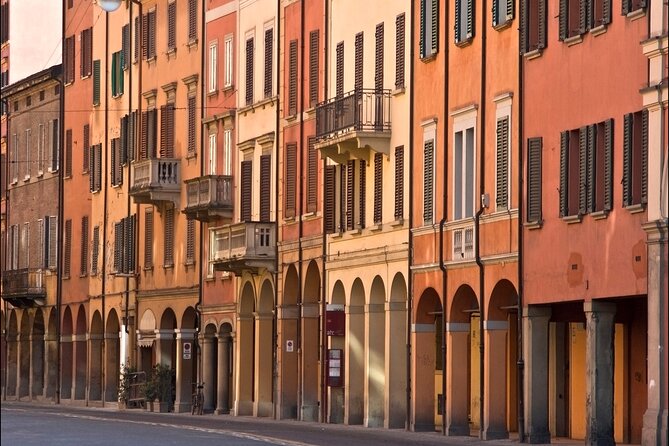
Now you shift from academic Bologna to devotional Bologna. You’ll visit Piazza Santo Stefano (also called Piazza delle Sette Chiese) for about 10 minutes.
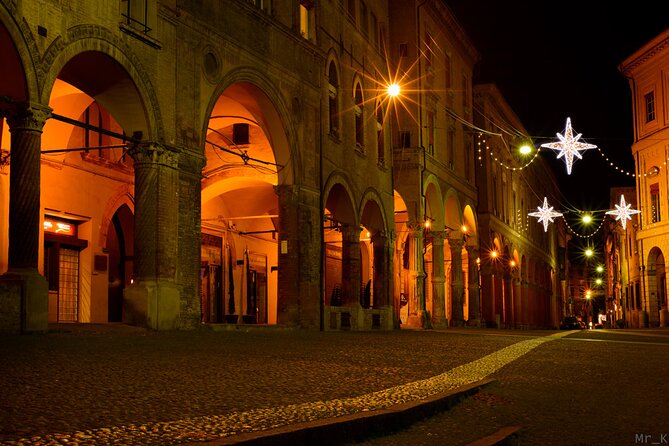
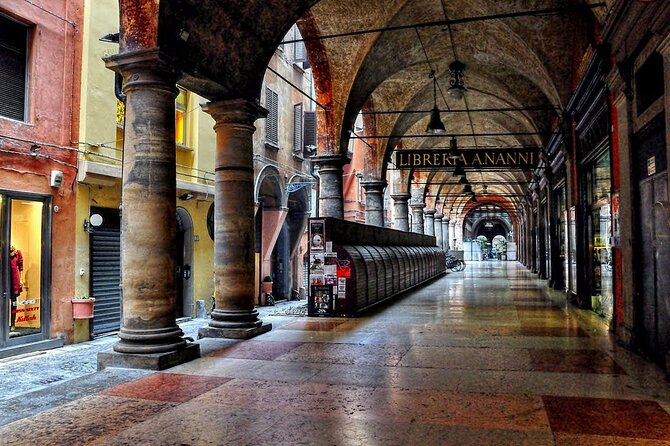
This is a pedestrian-friendly square near the start of via Santo Stefano, named for the church complex of Santo Stefano. It’s also a place where cultural events, flea-markets, and concerts happen, and the long sides of the square feature porticos.
Porticos are one of the reasons Bologna feels different from many Italian cities. They give shade, structure, and an easy walking flow. When you see them early, they stop being just an architectural detail and become part of how you experience the city.
Basilica-Santuario di Santo Stefano: a complex with layers of time
The tour continues to the Basilica – Santuario di Santo Stefano complex for about 30 minutes. The complex is locally known as Seven Churches and Holy Jerusalem, and it’s built from multiple religious edifices across centuries.
The components mentioned include:
- the Church of Saint Stephen (8th century)
- the Church of the Holy Sepulchre (5th century, rebuilt on a Roman temple)
- Saints Vitale and Agricola (5th century, rebuilt in the 12th century)
- the Courtyard of Pilate
- the Church of the Trinity or of the Martyrium (13th century)
There’s one key planning note: the complex is closed on Mondays at the time of this tour’s information. If your dates include Monday, this is a big reason to double-check your schedule before you book.
Strada Maggiore and Casa Isolani: Bologna’s portico height story
Next comes the area around Strada Maggiore, about 10 minutes, where your guide points out the gallery linking Strada Maggiore and Piazza Santo Stefano.
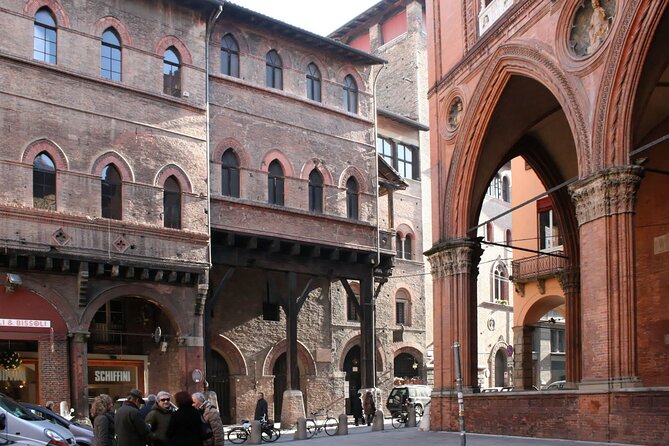
On one side, the entrance looks like a medieval house with Romanesque-Gothic elements. On the other side, it shifts to a Renaissance-style senatorial palace vision. You’ll also hear about the Isolani family and their Cypriot origin, which ties to the surname.
Then comes one of the most eye-catching Bolognese arcades described here: the Casa Isolani. The highlight is the scale of the wooden portico. The oak beams are listed at about 9 meters, supporting the third floor. The building dates to the middle of the 13th century and is said to be the highest wooden portico in the city.
Why I think this stop works
Even if you don’t care about architectural dates, porticoes tell you how people lived, moved, and protected themselves from weather. This is one of those Bologna “wow” facts that changes how you look at streets afterward.
Le Due Torri: Asinelli and Garisenda, built by families
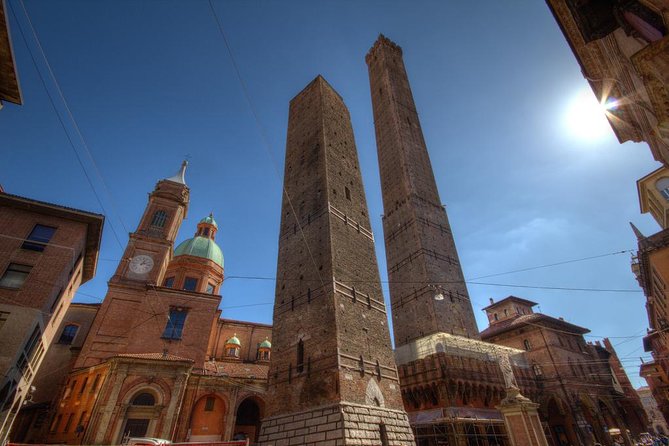
Your final major stop is the Two Towers at Torre degli Asinell i and Torre della Garisenda, about 10 minutes. They’re Bologna’s symbol and the most prominent leaning towers.
You’ll learn their basic origin: both towers were built between 1109 and 1119 by families, and their names come from those builders. The towers sit where roads leading to five gates of the old ring wall intersected, which helps explain why they became such strong city markers.
When you finish here, it feels like a payoff. You’ve walked from civic square to sacred complex to university building, and the towers are the skyline anchor connecting it all.
Your tour ends near the Garisenda Tower at Piazza di Porta Ravegnana.
Price and value: $125.10 per group, and why that can be a good deal
Let’s talk value in plain terms. The tour is $125.10 per group up to 10, lasting about 3 hours, and it’s private with a professional guide.
If you fill the group limit, you’re effectively looking at around $12.50 per person for guide time (tickets are mostly free at the stops listed). If your group is smaller, your per-person cost rises, but you still benefit from two things:
1) you’re not paying extra for a long list of paid admissions (most listed entries are free), and
2) you’re buying time with a local resident guide who can connect the dots across the city.
Also, because transportation and tickets are not included, you can keep your expenses transparent. You just need to think about your own getting-between-stops costs, plus any optional entrance like the €3 anatomy theatre.
Tips to make your 3 hours feel like more than 3 hours
A short tour only works if you show up ready to absorb. Here’s how to get better value from the route.
- Dress for church entry. You’ll visit places of worship, and a dress code is required. Plan for it early so you don’t lose time at the door.
- Bring a flexible mindset about timing. The route hits many highlights, so you’ll get good sightlines and context, not a slow museum-style pace everywhere.
- Use the food stop strategically. Quadrilatero is an orientation stop for the market vibe. Since food/drinks aren’t included, go in with a plan for what you want to buy later.
- Double-check if you’re traveling on Monday. The Seven Churches complex is listed as closed on Mondays. If that’s your top priority, pick a different day.
- Meet at Piazza Maggiore on time. That first anchor stop sets up the whole day’s navigation.
Should you book this Bologna private tour?
I think this one is a smart choice if you’re a first-timer who wants quick orientation plus real stories, and you’d rather pay for a guide than fight crowd flow. It’s also a great fit if your group includes mixed interests—architecture, major monuments, and the food-market atmosphere—because the route covers all of it without dragging.
I would hesitate only if you’re the type who wants to sit and linger for long stretches at a single site, because 3 hours is designed for breadth. And if your dates land on a Monday, make sure the Santo Stefano complex closure won’t derail what you came to see.
If that all lines up, booking makes sense. You’ll finish the day with Bologna’s key landmarks in your head and a route you can replay on your own with confidence.
FAQ
How long is the Bologna tour?
It lasts about 3 hours.
Is the tour private and how large is the group?
Yes, it’s a private tour. The price is per group up to 10 people.
What language is the tour offered in?
The tour is offered in English.
Where does the tour start and end?
It starts at Piazza Maggiore, 1/e, Bologna and ends near Garisenda Tower at Piazza di Porta Ravegnana.
Are entrance tickets included?
Most stops are listed as free, but tickets are not included. Food and drinks are not included either.
Is there a dress code?
Yes. A dress code is required to enter places of worship, and you may risk refusal if you don’t meet the requirements.
Is the Santo Stefano complex open every day?
The complex is listed as closed on Mondays.
More Bologna City Tours


More Tour Reviews in Bologna
After something different? More ways to fill a day in Bologna and across Emilia-Romagna





City Tours, compared.
 ★ 4.5City Center Walking TourFrom $263,478 reviews
 ★ 3.7Open Bus City Tour and Local Food TastingFrom $46550 reviews
 ★ 4.6City Highlights Walking Tour with Local GuideFrom $17219 reviews
 ★ 4.9City Center Guided Wine Walking TourFrom $70210 reviews
 ★ 4.2City Walking TourFrom $27203 reviews
 ★ 3.5Bologna City Red Bus and Food tastingFrom $4046 reviews
 ★ 4.0City Walk with Audio Guide in 7 Languages on your PhoneFrom $941 reviews
 ★ 4.0Modena City Walking TourFrom $3038 reviews