
Reviewed · BOLOGNA WALKING TOURS & CITY HIGHLIGHTS
Ferrara Walking Tour with Audio and Written Guide
Ferrara rewards slow, informed wandering. This walking tour with audio and text helps you connect the dots across key sights in Ferrara, from character-packed streets to the big-ticket fortress. You get a mobile-ready digital guide that works on your schedule, and you finish in the relaxing Giardini della Certosa area instead of backtracking.
Two things I really like: the freedom to listen or read at your own pace, and the practical stop-by-stop commentary that keeps things interesting without turning into a history lecture. There’s also solid help for food, with restaurant advice built in for when you’re hungry and deciding what to order. One consideration: you’ll need a smartphone with an internet connection to use the digital guide, so plan for spotty connectivity.
The route is designed to steer you through Ferrara’s most recognizable sights—Via delle Volte, the Jewish ghetto area, Piazza Trento e Trieste, the cathedral, the municipal palace, and Corso Ercole I d’Este. The main thing to budget for is Castello Estense: the walk passes it, but the castle ticket is separate and costs 12€.
In This Review
- Key highlights worth caring about
- A smart way to see Ferrara without being rushed
- How the audio and text guide works on your phone
- Getting your bearings: where the walk starts and ends
- Via delle Volte: Ferrara’s medieval street heartbeat
- Jewish ghetto detour: 13th-century continuity in a small span
- Piazza Trento e Trieste and the cathedral focus
- Comune di Ferrara and Lo Scalone: the architecture story you can see
- Castello Estense: the one stop with the separate 12€ ticket
- Rotonda Foschini: a free courtyard with a reason to look up
- Corso Ercole I d’Este and Palazzo dei Diamanti details
- Price and time: what $7.81 really buys you
- Practical comfort: headphones, group size, and moving at your pace
- Who this Ferrara walking tour is best for
- Should you book this Ferrara audio walking tour?
- FAQ
- Is this tour self-paced or do I follow a guide in a group?
- What languages are available for the audio and text?
- How long does the Ferrara walking tour take?
- Do I need tickets for Castello Estense?
- Do I need internet on my phone?
- Can I cancel for a full refund?
Key highlights worth caring about
- Self-paced audio + written guide: listen or switch to text whenever you want.
- Ferrara’s medieval street texture: Via delle Volte is the kind of street you feel in your legs.
- A meaningful detour: the Jewish ghetto detour helps you understand the city beyond the postcard stops.
- Central public-square hits: Piazza Trento e Trieste and the cathedral anchor the route.
- Lo Scalone at the town hall: the municipal complex has an architectural storyline you’ll know to look for.
- One extra-ticket stop: Castello Estense costs extra, but it’s the big payoff.
A smart way to see Ferrara without being rushed
This tour works because it respects reality. You’re in Ferrara—one of those cities where good walking matters—and not everything needs to be timed to the minute. Instead of herding you along, the digital guide gives you prompts and context so you can move when you want, pause when you want, and skip ahead if you decide you’d rather spend your energy on another stop.
That approach is especially useful if your energy is mixed. Maybe you’ll want to spend longer outside the cathedral and on the streets, and maybe you’ll need a breather before the castle. The whole route is built to fit an easy 2 to 3 hours, with the longest stop being Castello Estense at about an hour.
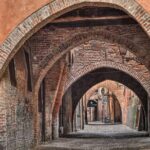
More of the old town on foot, towers and squares and back streets.
How the audio and text guide works on your phone
You’ll use a smartphone to access the digital guide, and you’ll need internet to run it. That means you should avoid planning to rely on roaming or barely-there Wi‑Fi once you’re outside your hotel. The good news is the setup is flexible: you can listen through your phone speaker or, if you have them, through headphones.
The guide also offers audio and text in multiple languages—English, Spanish, Italian, German, and French—so it’s easy to share the experience with anyone in your group who reads better in another language. There’s also a built-in bias toward practical sightseeing: tips for monuments, history, and small curiosities, plus restaurant advice at the end to help you keep the momentum after your walk.
Getting your bearings: where the walk starts and ends
The start point is listed simply as 44122 Ferrara, and the end point is very clear: Giardini della Certosa, Via Borso 9, 44121 Ferrara. Finishing in the gardens is a nice touch because it gives you a natural landing spot—somewhere to sit, cool down, and make your next decision without forcing you back into tight streets.
If you’ve ever struggled finding a start pin in a historic center, you’re not alone. The best trick is to open Google Maps before you leave, paste the start area, and confirm you can see a nearby landmark. Once you’re on the route, the guidance makes the walking flow feel obvious.
Via delle Volte: Ferrara’s medieval street heartbeat
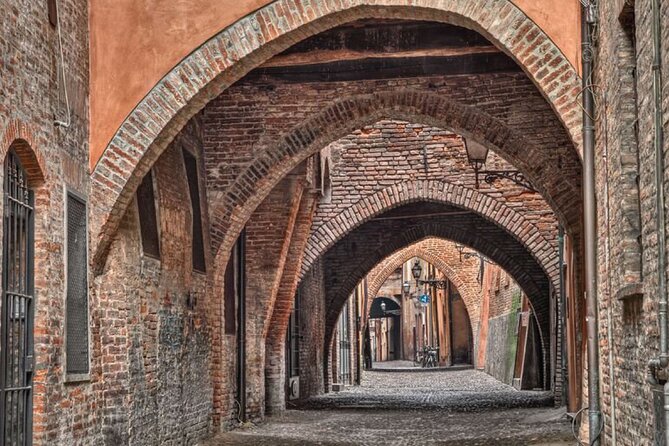
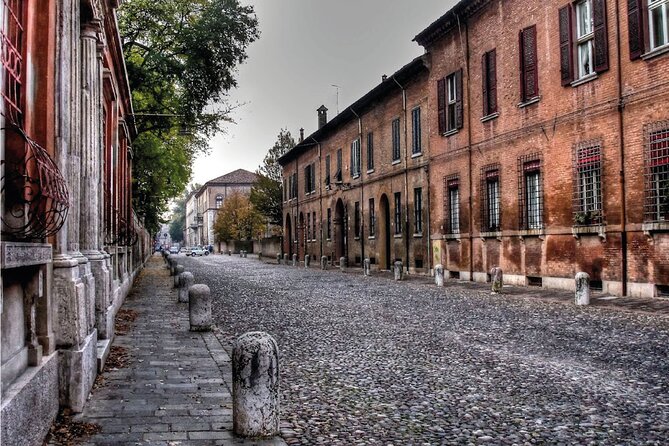
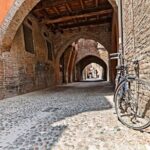
The tour begins with Via delle Volte, which you’ll quickly understand is not just a pretty street—it’s the medieval core of Ferrara’s city fabric. The guide explains how this straight passage developed along an old embankment connected to the Po River route, which was diverted in 1152. Even if you only catch part of that story while walking, it changes how you read the street: you start noticing the layers behind the bricks.
What I like about this first stop is that it sets a theme fast. You’re not jumping straight into a building; you’re getting oriented to the city’s medieval structure. The only mild drawback is timing—this stop is about 20 minutes—so if you love lingering for photos, you might want to give yourself an extra few minutes before you move on.
Jewish ghetto detour: 13th-century continuity in a small span

Before you reach the main square area, there’s a short detour to the Ghetto Ebraico. What makes this stop meaningful is the context: the guide frames Ferrara’s Jewish community as continuously documented since the 13th century, well before the ghetto concept took its later form.
This is a “small detour, big understanding” moment. It doesn’t eat your whole afternoon, but it adds depth to what you’re about to see in the civic center. If you’re the type who likes to understand the city’s human history—not just its architecture—this part is worth your attention.
Set your own pace with an audio guide or a city quest.

Piazza Trento e Trieste and the cathedral focus

Next you land at Piazza Trento e Trieste, Ferrara’s most important square. Even in medieval times it served as the centerpiece, when it was known as Piazza del Mercato delle Erbe—where the market took place. That means you’re standing in a space that has always pulled people in for daily life, not only ceremonies and monuments.
From there, the route points you to Ferrara Cathedral, the city’s key church. The guide highlights why it doesn’t look like a single-style building: over centuries, it underwent multiple restorations and alterations, with enrichment during the Renaissance and Baroque periods. In practice, that means you’ll likely notice different “moods” in the architecture as you look around, instead of trying to force everything into one style box.
One practical tip: give yourself time to look up and around the facade and immediate surroundings before you assume you’ve seen it all. Cathedral exteriors reward slow attention, and the guide helps you know what details to look for.
Comune di Ferrara and Lo Scalone: the architecture story you can see
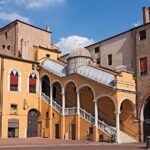
The tour then moves to Comune di Ferrara – Palazzo Municipale, the town hall complex. The square occupies the area that used to be the courtyard of the Ducal Palace, so you’re basically seeing civic power where ducal life used to spill out.
The standout here is “Lo Scalone,” the famous staircase element. The guide specifically calls it out, which is great because it prevents that common tourist mistake of walking past the important bits while hunting for the most obvious photo angle. Even if you just pause for a few minutes, you’ll start noticing how the building communicates status and movement.
If you’re traveling at a slower pace, this is a good stop to linger at, because it’s easy to underestimate how much you can absorb from one architectural feature.
Castello Estense: the one stop with the separate 12€ ticket
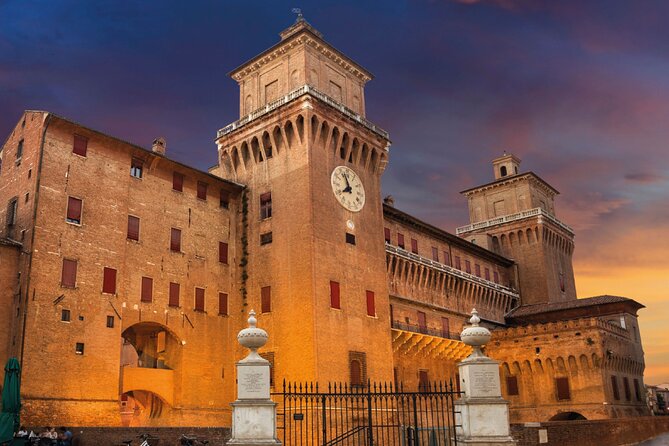
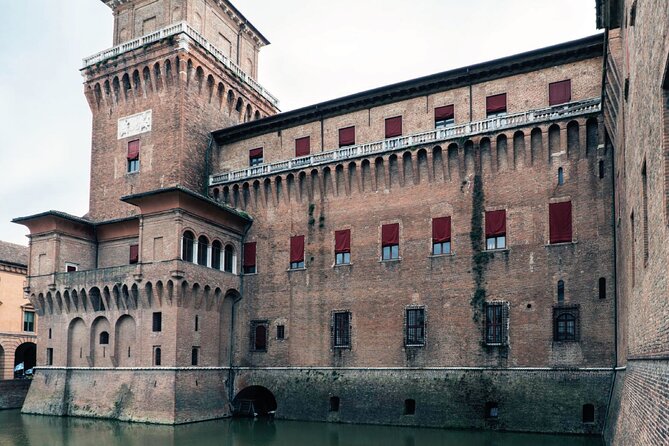
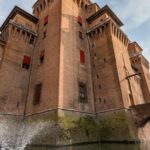
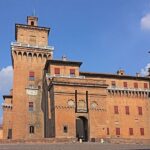
No matter how much you love streets and squares, the route’s “anchor attraction” is Castello Estense. The guide gives you the story behind the castle and frames it as one of the proud symbols of Ferrara.
Here’s the key practical point: the castle ticket is not included. You’ll need to budget 12€ if you want to go inside. The tour allocates about 1 hour for the castle stop, which is usually enough time to see the essentials without turning it into a half-day project.
The value trade-off is real. Paying the extra 12€ can be worth it if you want the full fortress experience rather than just reading about it from the outside. But if you’re short on time or castle fatigue is a thing for you, you can still benefit from the walking commentary up to that point, and decide your level of commitment on the ground.
Rotonda Foschini: a free courtyard with a reason to look up
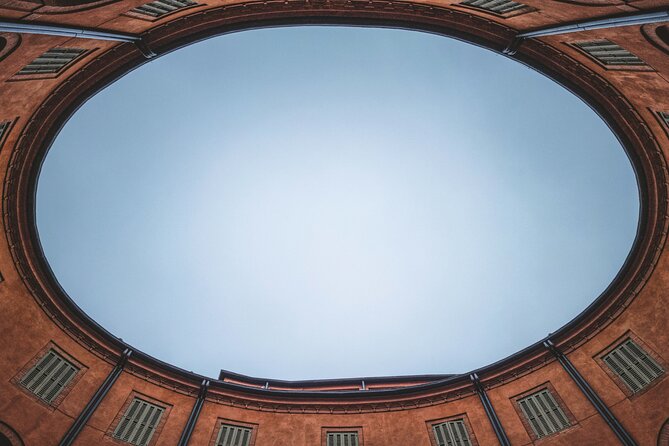
After the heavier moments, the tour shifts to something calmer and more visual: Rotonda Foschini. This is the courtyard of the Municipal Theater of Ferrara, and it’s accessible on foot for free. The guide also nudges you to look up for a special view, which is exactly the kind of small instruction that makes a stop feel purposeful rather than accidental.
This stop is short—about 5 minutes—but it breaks the rhythm in a good way. If you’ve been reading about architecture all morning, it’s a nice chance to reset with a straightforward, low-pressure viewpoint.
Corso Ercole I d’Este and Palazzo dei Diamanti details
The final stretch runs along Corso Ercole I d’Este, another characteristic Ferrara street where the guide encourages you to look up at the buildings. This is where Ferrara’s personality shows through: the city rewards vertical attention—facades, angles, and the way streets frame views.
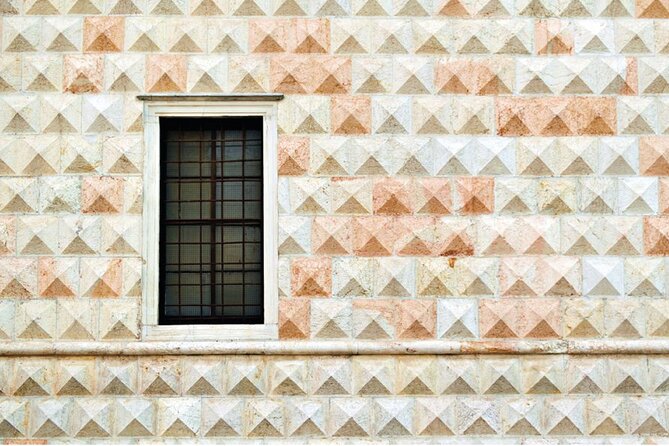
One highlight the guide points out is Palazzo dei Diamanti. It’s famous for its distinctive facade, but what the guide adds is a story that gives the details a reason to exist. If you’re the kind of traveler who likes to understand why something looks the way it does, this is a satisfying capstone before you end in the gardens.
Price and time: what $7.81 really buys you
At $7.81 per person, this tour is priced more like a digital sightseeing tool than a traditional guided tour. And that’s the point: you’re paying for a well-structured route plus audio and written guidance in multiple languages, with tips for monuments, history, curiosities, and restaurant suggestions.
The main extra cost to keep in mind is Castello Estense at 12€. Even with that, the overall value can still be strong if you use the guide properly—meaning you actually pause at stops and let the commentary shape your attention. If you’re the type who walks past landmarks without reading, you might feel the cost more than the value.
Timing is also honest. Expect 2 to 3 hours, and you’ll likely end up closer to the high end if you spend real time at the cathedral and the castle. Since it’s self-paced, the tour won’t punish you for taking longer with a detail.
Practical comfort: headphones, group size, and moving at your pace
A few small logistics matter here. The tour supports service animals, and it’s near public transportation. The group size limit is up to 104 people, which sounds large, but the experience itself stays independent because you’re using the digital guide rather than following one strict guide line.
The biggest practical comfort item is your phone setup. Bring a charged battery, and consider offline prep if your mobile signal is unreliable. Since you need internet to access the guide, you don’t want to discover midway through Via delle Volte that your data plan is the real limiting factor.
Who this Ferrara walking tour is best for
This is a strong fit if:
- You want a high-signal route through Ferrara highlights without committing to a timed guided group.
- You like switching between listening and reading depending on what you’re seeing.
- You want one afternoon route that balances major monuments with street-level context.
It’s not the best fit if:
- You don’t like relying on your smartphone.
- You want only interior tickets included. Castello Estense requires an extra purchase.
- You need very tight, fully scheduled pacing rather than self-directed timing.
Should you book this Ferrara audio walking tour?
I’d book it if you’re doing Ferrara for a short visit and want a reliable route that helps you understand what you’re looking at. For the price, the digital format is the value engine: you get a guided sequence, multiple language support, and practical restaurant guidance without spending time coordinating a group.
Skip or reconsider if you already know you won’t use the audio/text features, or if you’re likely to struggle with internet access on your walk. But if you can keep your phone ready and you enjoy reading a city through its streets and buildings, this tour is an easy win.
FAQ
Is this tour self-paced or do I follow a guide in a group?
It’s designed as a digital guided walk that you do on your own. You use the audio and written guide through your smartphone as you walk between stops.
What languages are available for the audio and text?
The guide includes audio and text in English, Spanish, Italian, German, and French.
How long does the Ferrara walking tour take?
The tour is listed as approximately 2 to 3 hours.
Do I need tickets for Castello Estense?
Yes. Castello Estense is not included, and the ticket cost is listed as 12€ if you choose to enter.
Do I need internet on my phone?
Yes. You’ll need a smartphone with an internet connection to use the digital guide.
Can I cancel for a full refund?
Free cancellation is available. You can cancel up to 24 hours in advance for a full refund.
More Self-Guided Tours and City Quests
More Bologna Walking Tours


More Tour Reviews in Ferrara
After something different? More ways to fill a day in Bologna and across Emilia-Romagna



Bologna Walking Tours & City Highlights, compared.
 ★ 4.5City Center Walking TourFrom $263,478 reviews
 ★ 4.8Walking Food Tour with a Local GuideFrom $90882 reviews
 ★ 5.0Private Half Day Parma Food Walking TourFrom $134561 reviews
 ★ 3.7Open Bus City Tour and Local Food TastingFrom $46550 reviews
 ★ 5.0Bologna Private Highlights & Hidden Gems Tour with a LocalFrom $77359 reviews
 ★ 4.6City Highlights Walking Tour with Local GuideFrom $17219 reviews
 ★ 4.9City Center Guided Wine Walking TourFrom $70210 reviews
 ★ 4.2City Walking TourFrom $27203 reviews
Browse the lists this tour appears in